This is a page on stamp anomalies. It is just a place where I can put all the things which don't belong in the main galley because I don't want to clutter it up. I feel it is already cluttered enough with unfortunate complexities.
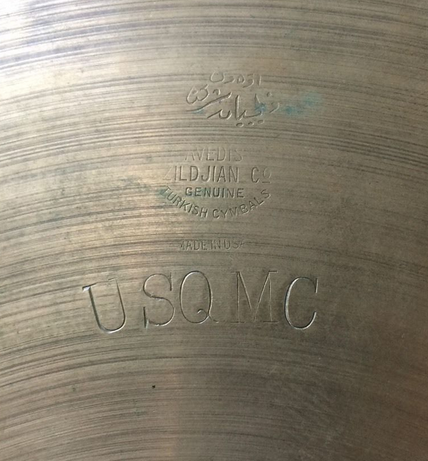
Image: USQMC on a 1930s Pre Trans Stamp
There is also a single example of a U S on a cymbal from the 1930s.
Image: U S on a 1930s Pre Trans Stamp
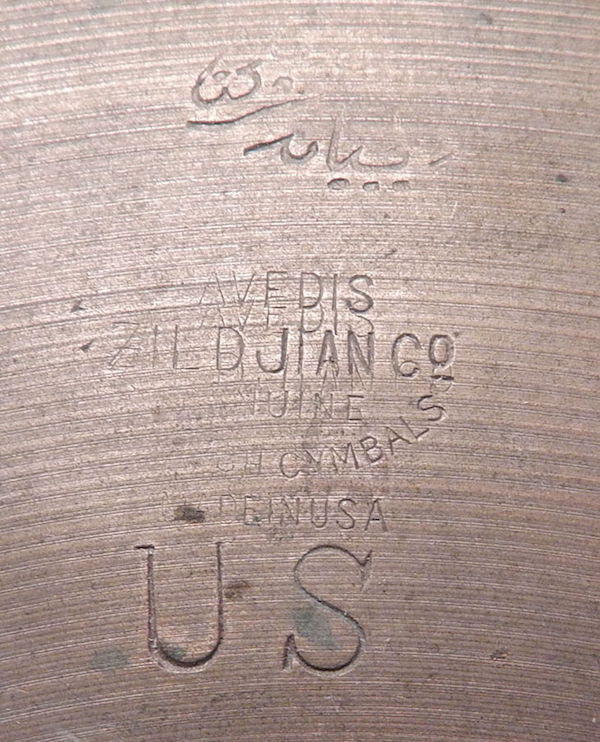
There are just 2 cymbals with military markings out of 54 cymbals (4%) so they are not very common.
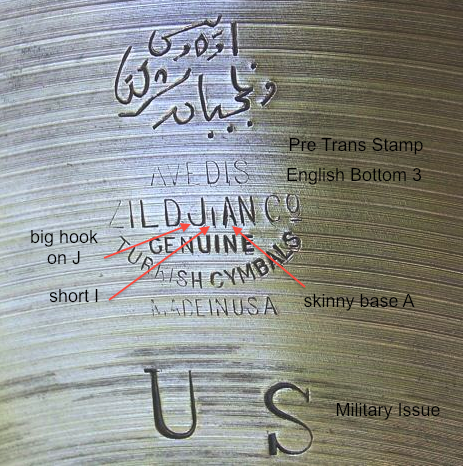
Beginning in the 1940s there are a number of cymbals which just have U S stamped on them. I've got 10 of these in my records out of 53 cymbals (19%). So military markings are more common in the 1940s. But it is still the case that most 1940s cymbals do not have military markings.
Image: U S on a 1940s Pre Trans Stamp
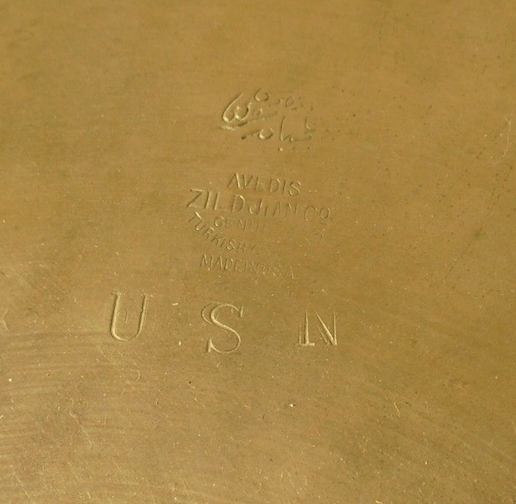
I've also got a single example of a U S N (United States Navy) version. Same U and S and you just put an N on the end. We can also tell from the variable alignments that the U and the S and the N are three different dies being struck.
Image: U S N on a 1940s Pre Trans Stamp
In addition to the U S and U S N, the S gets reused on its own to signify Second. The earliest example of this non military use comes from the same production era.
Image: S (second) on a 1940s Pre Trans Stamp
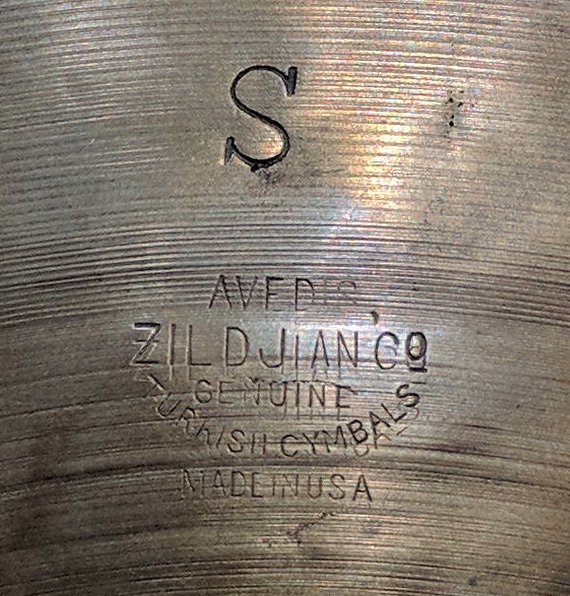
This Ziljdian trademark has no Ottoman section applied, and just the S on its own where the Ottoman would normally be. Later in the 1950s there are some cymbals which have just the S and no other trademark, and some where there is a complete trademark plus the S. In some cases it is relatively easy to see the flaw which caused the cymbal to be marked as a second. In this case there is an area under the trademark where the surface shows a foundry artifact.
Image: flaw on an S (second) on a 1940s Pre Trans Stamp
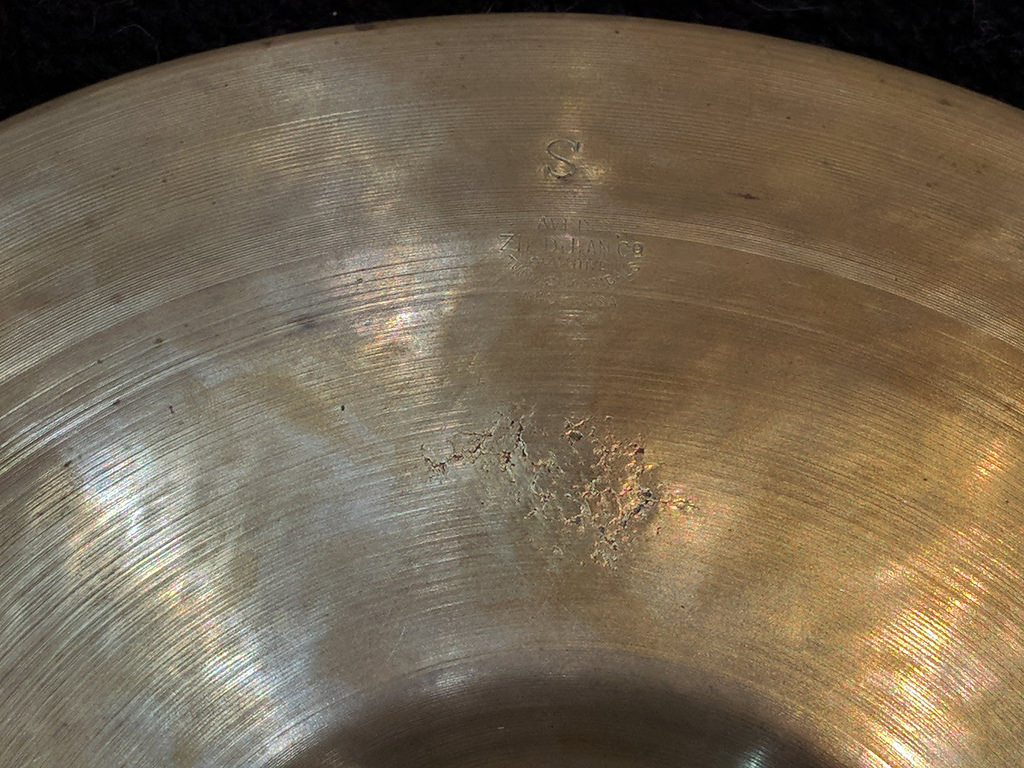
In other cases there isn't anything as obvious as this which would lead the tester to classify the cymbal as a second. If you come across an S on a cymbal but no other letters suggesting military markings, then it was probably classified as a second.
I haven't come across any military stamps on cymbals which have the 1940s Trans Stamps (type 1 and type 2). They might be out there and I just haven't spotted any yet.
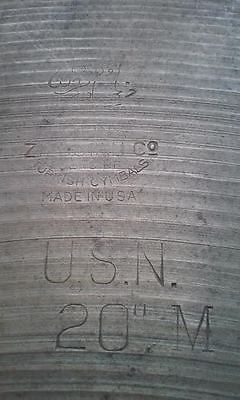
Beginning with the 1950s Trans Stamps (type 3 and type 4) there are several cymbals which have U.S.N. (Navy), a diameter stamped in, and either the letter M or H. The font has changed on these from the earlier (pre Trans) serif font. We don't know for sure what the M or H might mean. They might be Medium and Heavy, but I'm wanting a bit more evidence before I declare that strongly supported. The two 16" examples are suggestive where the H weighs 1585g and the M weighs 960g. But I'm not so sure that the 20" M at 1553g really counts as Medium. Yes back then cymbals tended to be lighter than they are now, but 1553g is still very light for a 20" Trans Stamp. Maybe they didn't have dies to put on an L for light or T for Thin or C for Crash.
Image: U.S.N. on a 14" 1950s Trans Stamp (type 4)
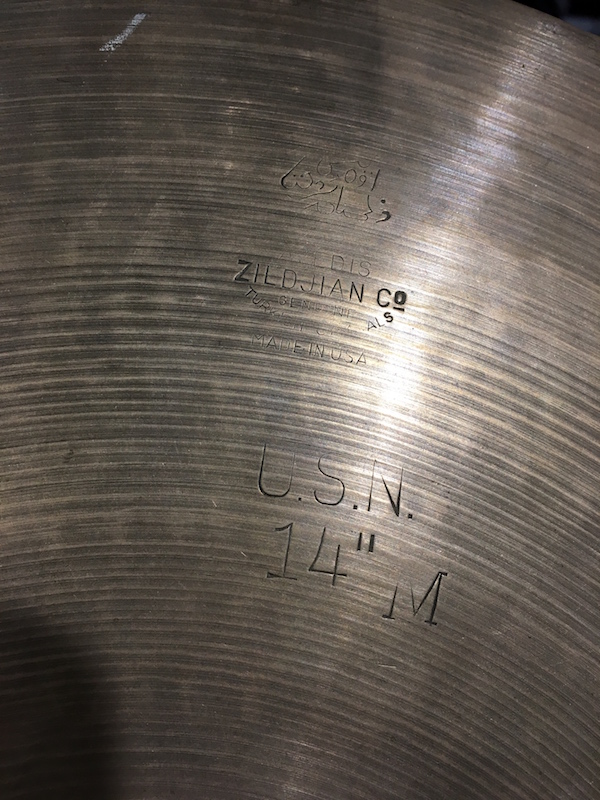
Image: U.S.N. on a 16" 1950s Trans Stamp (type 4)
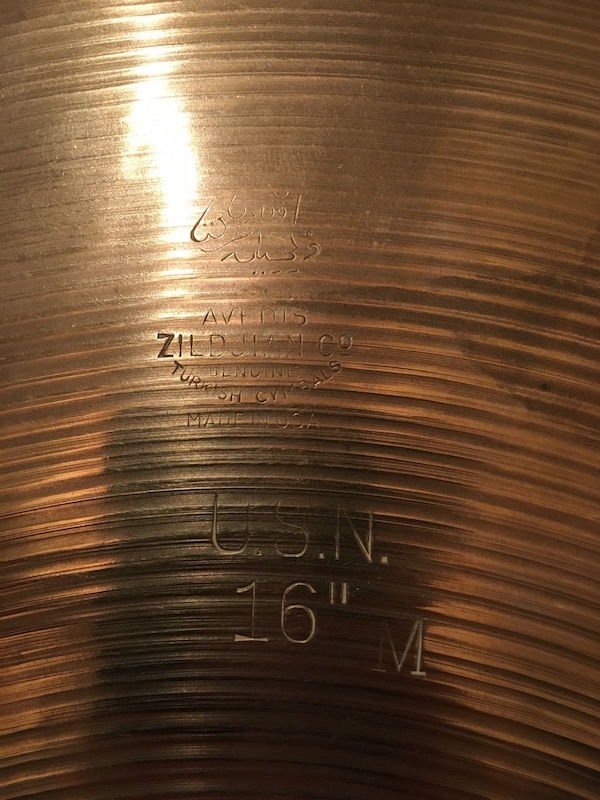
Image: U.S.N. on a 16" 1950s Trans Stamp (type 3?)
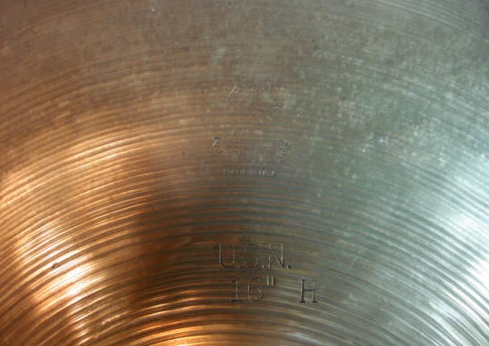
Image: U.S.N. on a 20" 1950s Trans Stamp (type 3)
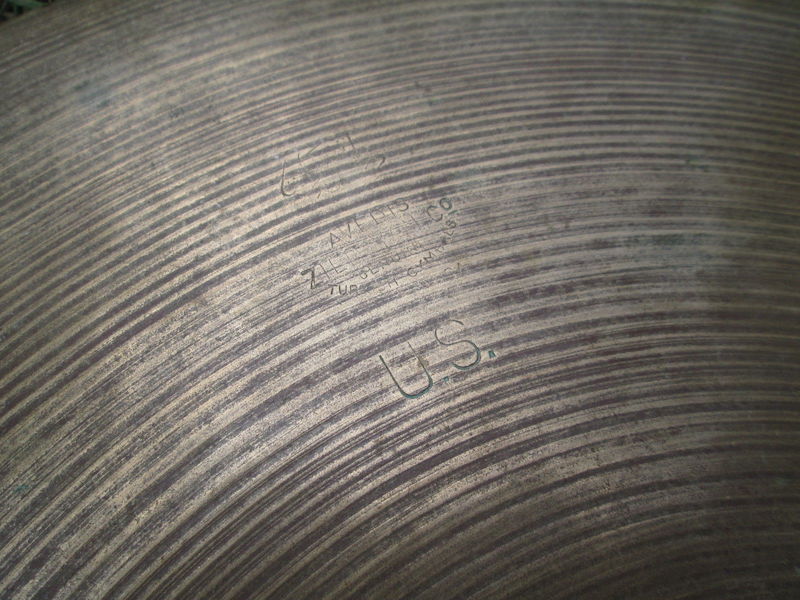
In addition there is a pair of hats where one had a Type 3 Trans Stamp and no military markings, and the other was a Type 4 Trans Stamp which is marked U.S. with no diameter. This version uses a sans serif font which looks like the same one used for the U.S.N. Trans Stamps, and clearly different from the serif font used on the older (1940) Pre Trans stamp U S marked cymbals.
Image: U.S. on a 15" 1950s Trans Stamp
If you know anything more about the meaning of these stampings or have more examples please let me know. For now, it appears that there are distinct stylistic differences between the 30s, the 40s, and the 50s in the military stamps added.
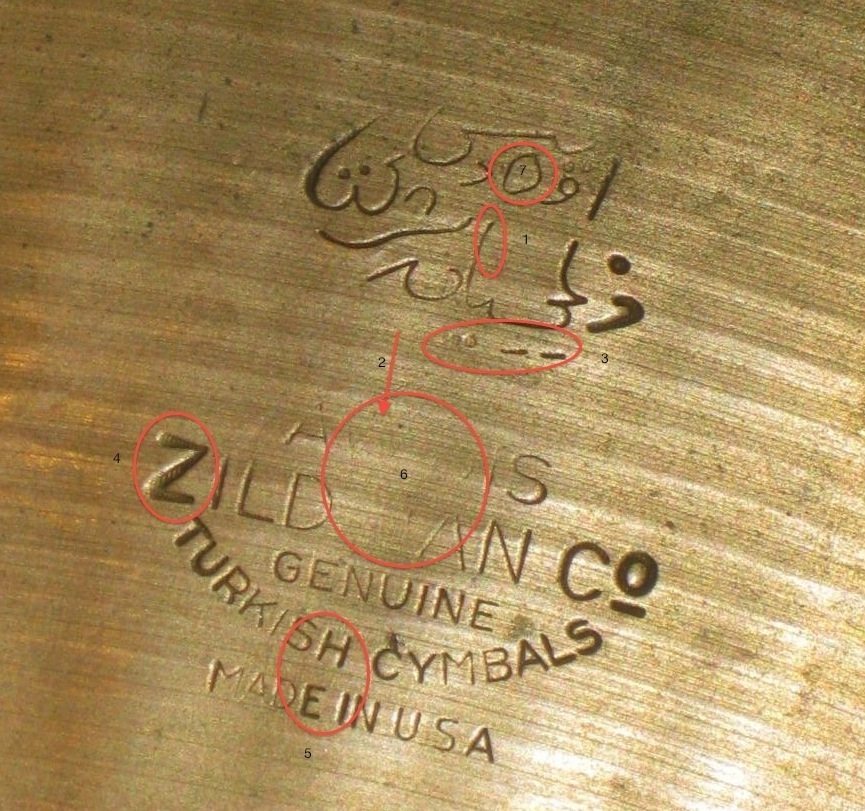
There is also a one off stamp which appears to be early on several stylistic grounds and it also has the diameter struck into the surface of the cymbal. Call it an anomaly among anomalies.
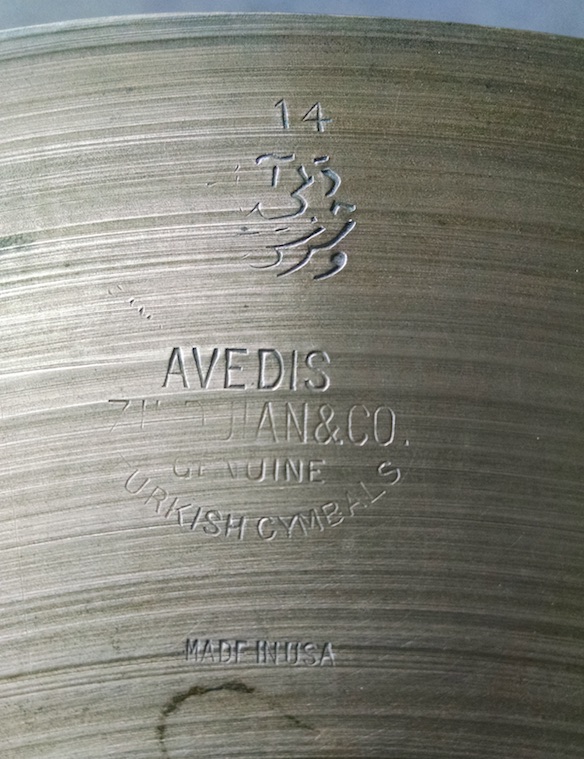
It has a 14 at the top which is the cymbal diameter. The Ottoman section has some characters it shares with the more familiar Ottoman section, but it isn't that close. The Zildjian & CO. is unusual in having CO. which isn't seen in trademark die stamps until 1982 although it does sometimes appear in printed material in the interim. It is also unusual in having the ampersand & there. The ampersand & is not seen in a trademark until the later 70s A Zildjian & Cie trademark. The alignment of AVEDIS over Zildjian & CO. seems unusual because the tool and die maker has the AVEDIS visually centered over the entire line Zildjian & CO. and this makes the alignment a little different from most other trademarks. The trademark appears to have the MADE IN USA (no dots) struck separately from the TURKISH CYMBALS (variable distance). It might fit between the Pre Trans Stamps and the Trans Stamps, but with only one known example it is hard to say for sure. I've just put it here because it needs to go somewhere but isn't yet "ready for timeline".
My currently favored explanation of how these cymbals with Trans Stamp like hammering and 1960s looking stamps came about is that they were produced in the mid 1950s but not stamped and shipped out until the early 1960s. There have always been stories about cymbals made in the mid 1950s and not stamped until 6 years later. Once cymbals were produced they were put into the vault to rest. They stayed there until they were selected to fill an order. Only at order filling time was the die stamp pressed in.
Another possibility of course is that the same die was used in the mid 1950s and the early 1960s. For some reason these dies were then put away for some years (during the Large Stamps and late 50s Small Stamp eras) but used again in the 1960s. The pattern we see in the data would be the same.
Alas I have no evidence for or against this stamp being from the precise year 1954. I only call it that because Bill Hartrick did, although neither the 1954 stamp nor the name appear in his original article. I also have no evidence that this die stamp was used for just one year (or a short time). One year is below the resolution one can get to using dating methods (separate page coming on dating methodology -- although you can read what Bill had to say about uncertainty in his original article). The duration of the 1954 stamp is unknown.
So the "1954 stamp" is at present not so much a unique die stamp, but a cymbal having a 1960s short stamp. plus a constellation of features (such as hammering and other production methods) which place these cymbals just after the Trans Stamps and before the Large Stamps.
Back in 2010 Bill Hartrick claimed that he could tell the difference, but he declined to state what the difference was, or his sample sizes, or his analysis methods.
Q: Hey Bill, wondering if you can help clear up the details about the elusive "1954" stamp. There are a few examples that have been identified as the 1954 stamp that had different heights, such as 1.25" tall and 1.5" tall. Is there an isolated, identifiable 1954 stamp, or are these cymbals that were made in '54 and stamped later with 60's stamps?
A: Yes there is a way to uniquely identify this trademark era by trademark characteristics alone, but size measurement is not one of them. The differences are very subtle, and I can tell you that this one will undoubtedly be the most difficult one to recognize of any and all the trademark types on both the A. and the K. side combined.and again from Bill Hartrick, explicitly saying he doesn't want to give anything away:Although the characteristics are there, the differences between the early 1960's trademark that Zildjian used and this one are very subtle indeed. To tease them apart requires very close attention to the minutest detail. One almost has to be a trademark forensics science expert to tell the difference between them. Fortunately I happen to be one of those.
The true challenge will be to teach the layman how to become one as well.
The rarest of the old A eras - 1954Rarest among all the trademarks that they ever used only because that trademark lasted for the least amount of time. I don't like talking much about trademarks anymore, but I think here I'll make an exception. Partly because the vast majority of drummers wouldn't be able to identify one of these even with an example trademark to go by; so I really don't feel like I'm giving away any timeline secrets by showing you this example.
Most know about "transitional stamps" and what that trademark looks like. If you watch cymbals on eBay you've heard them mentioned now and then. They are fairly rare and highly sought after because most drummers know that they were hand 100% hammered, and so they have that old school character to them. But very few if any know anything about the 1954 era, when cymbals that were virtually the same as the earlier trans stamps were being made but without a version of the trademark that could be as easily recognized as unique. In fact these cymbals are easily confused with early 1960's cymbals.
and in addition, Bill saying why he doesn't want to give anything away in January 2010:
I don't want to get into details of what I mean right now. I've already had too much of my material plagiarized by wanabee trademark experts with their own homemade versions of a timeline. I don't want to give out anything that could be used by someone else to make them seem credible. And that's also the reason that there's no timeline available for everyone to see right now.I can help people analyze their trademarks without going into every detail as to how I came did it or I can refuse to help with anything at all. I've chosen the first option.
You may or may not know this, but for years I had a timeline for both A's and K's posted up on Cymbalholic with photos and detailed explanations about how to identify and date each one. Then along came a guy named Winnie Manserek who took some of my information directly off my timeline and posted it on his own website claiming it as his own. He helped to convince me that I should remove this information from the internet at least for the time being. I'm waiting for the right time to do this project which will involve a website that will restrict who has access to this information and a few other measures of security. And those who want access to the site will have to pay to get in as well.
In trying to put this web site together, I've tried to give full credit to Bill Hartrick for all his pioneering work. But since he has chosen to withhold information, we don't get the benefit of knowing the strength of his evidence or his conclusions. It's his evidence so he is free to do that. But it doesn't help encourage the virtuous cycle of science.
In the meantime, we've spent may hours testing various attributes to see if they distinguish between the 1954 stamp and 1960s short stamp. This hasn't yet succeeded, but I'm reporting it here so you know what doesn't work and what we've tried out. That's me trying to adhere to the principles of public good science. I'm not asking you to take my word for it. And you are welcome to all my raw data and evidence.
It is possible that since 2010, Bill has looked at larger sample sizes, done the statistical analysis, and seen that there isn't a significant difference between the 1954 stamp and 1960s short stamp. He may have changed his interpretation based on new evidence which has come to light in the intervening years. He has certainly accepted delayed stamping to explain a 1970s A Zildjian & Cie trademarked (but bottom hammered) cymbal he owns. This was a year or two after he stopped commenting on "1954 stamps" so I don't know if it changed his thinking. We may not find out his current thinking on the "1954 stamp" until his opus magnum book comes out. Or we may never find out what differences Bill Hartrick noted.
In the meantime a few of us got interested in replicating Bill's pioneering work and we've put in the hours. Thanks to Thundermug on CH for the observations on the English section regarding quirks. My own work was on the Ottoman portions. What we discovered is the quirks we thought might be "1954" vs "1960" are quite common on 1960s short stamps and in fact distinguish between the short (1 3/16") and tall (1.5") 1960s stamps. And while we are on the subject of short and tall, it turns out that the periodic claims of the 1954 being 1.25" tall are also untrue. The claims of 1.25" versus 1 3/16" are all down to measurement error or rounding error. The short stamps are in between at more like 1 7/32" which is what caused the confusion.
In addition to the trademark stamp itself, Cliff DeArment has contributed with his search for cymbals which look to have Trans Stamp hammering, the "1954 stamp" (aka 60s short stamp) and have the smaller mounting hole. The existence of these is another line of evidence that manufacture happened before the late 50s.
Since the original quirk research was undertaken I've looked at other areas on the stamp such as the relative height of MADE IN U.S.A versus TURKISH CYMBALS versus GENUINE. This does vary between different stamps, but it doesn't vary between the 1954 stamp and the 1960s stamps. I've also looked at other portions of the Ottoman section and other portions of the English section, but I haven't currently got an illustrated examples of that. When I get to it, it will be similar to this early version of my Trans Stamp analysis showing the areas under investigation at that time. I have looked at these areas (and more) for the 1954 vs 1960 stamps, but haven't found a significant difference yet:
Image: Trans Stamp Active Search Areas
As I continue to collect and analyze new information I'll update the numbers, this entry, and the main 1954 stamp gallery entry. This is all ongoing research.
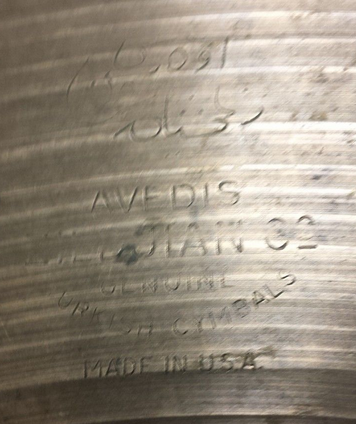
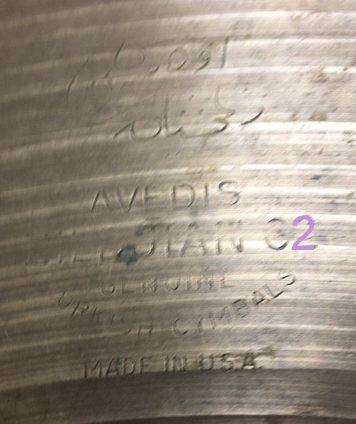
as if it said this (purple highlighting mine):
Image: The C2 Stamp Explained
And yes, that image is taken directly from an eBay auction for a ZILDJIAN C2 Stamp
in October 2015.
I've traced this misinformation back to as early as 2010 on
Drummerworld
although it doesn't seem to have spread further in 2010.
What I believe happened is a few others
researching the stamps on their cymbal came
across the original mistaken identity
(or an independent mistaken identity from post 2010)
and thought they also had a C2 stamp. As of
early October 2015 there were 5 Zildjian C2 stamps on eBay. New sellers come
along and do a search on eBay and find the others and similarly misidentify theirs.
And so it spreads.
Now Google gives enough hits on Zildjian C2 stamp so it has taken on a kind of "reality".
This entry is an attempt to overcome that. Folks...there is no Zildjian C2 stamp.
Image: A 370th Anniversary Cymbal
The die stamp is unusual in that it is a copy of the commemorative ink. So far
as we know this was used for just the one year.
Image: The 370th Anniversary Die Stamp
Image: A 375th Anniversary Cymbal
Image: The 375th Anniversary Ink Stamp
Image: A January 1st, 2000 Stamp
In addition to the one off millennium laser stamp there are a few recorded
which don't have the usual pattern of two upper case letters. These are
thought to be special endorser cymbals but we don't really know for sure. In
some cases they certainly seem to be:
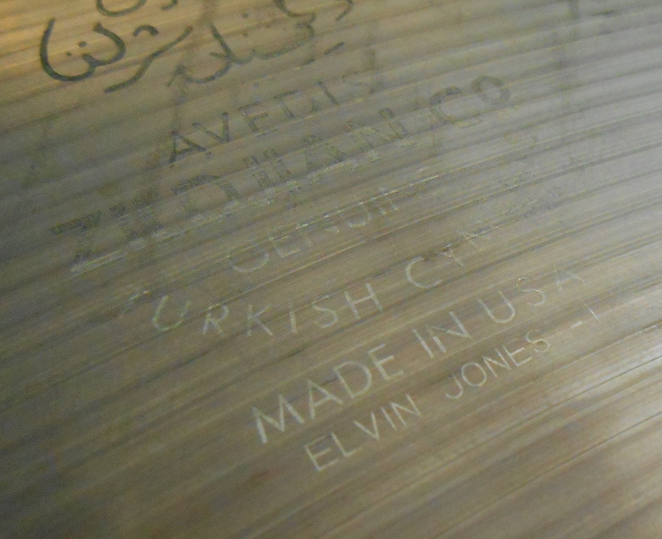
Image: An Elvin Jones laser Stamp
In other cases they could just be typos when telling the laser what to print
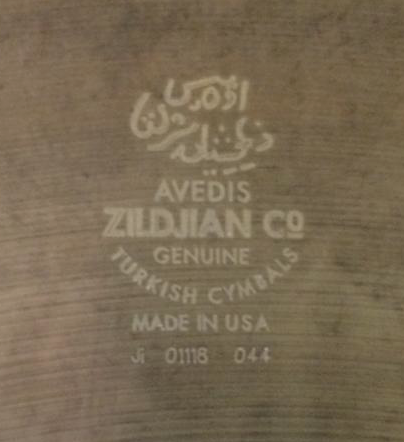
Image: A Ji laser Stamp
This could be a 2009 typo (JI) or it could be something else. If you have any other
examples please let me know.
or back to the introduction page
text stabilized 28 Dec 2016 4:00 PM
text last updated 15 Dec 2018 5:30 PM
The 370th Anniversary Series (1993)
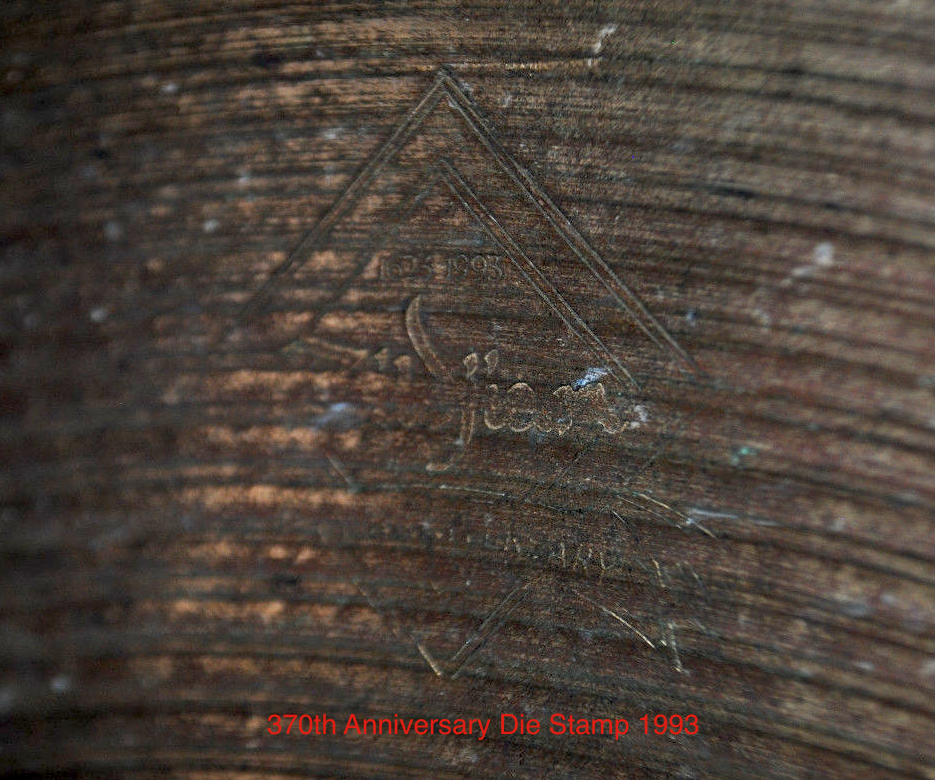
A special die stamp and associated ink stamp were created to mark the 370th Anniversary
in 1993. This was done the year before laser stamps began.
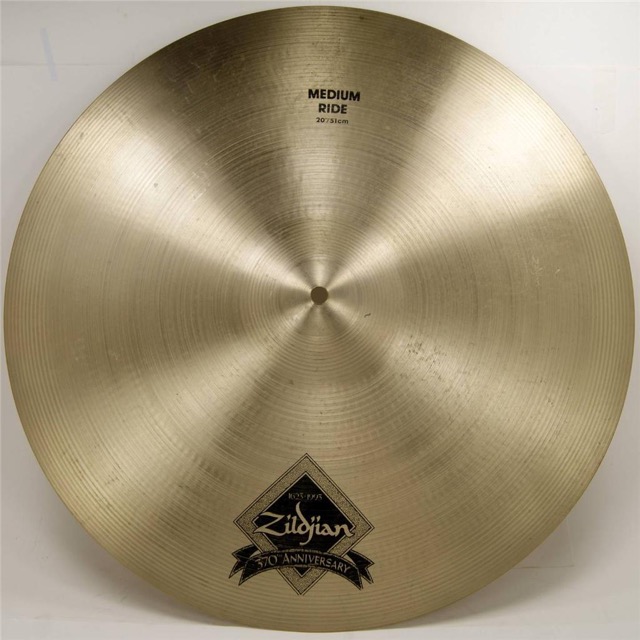
The 375th Anniversary Series (1998)
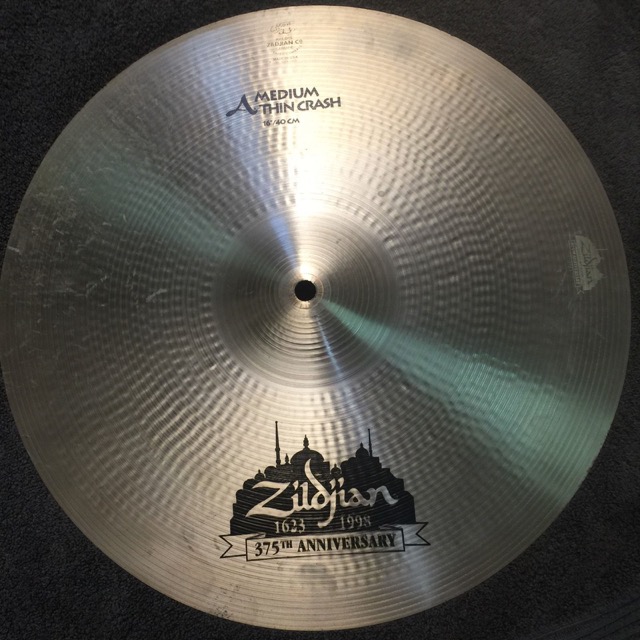
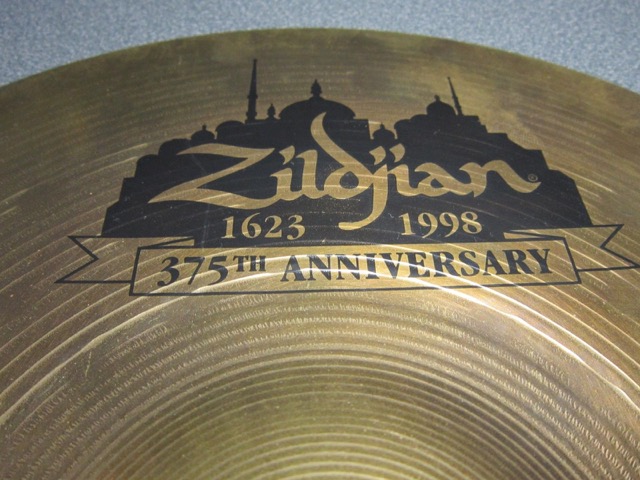
A special laser stamp and associated ink stamp were created to mark the 375th Anniversary
in 1998. These cymbals have laser stamps at both 12 o'clock (the standard laser stamp
in the standard position for the early laser years) as well as a special
Istanbul night skyline laser stamp at 3 o'clock, plus a corresponding ink skyline stamp.
Unusual Laser Stamps
Most laser stamps follow the standard convention of encoding the year in the
first two letters. But just when you thought it was going to be easy to
get the year from the serial number on any cymbal after 1994...there are a few exceptions.
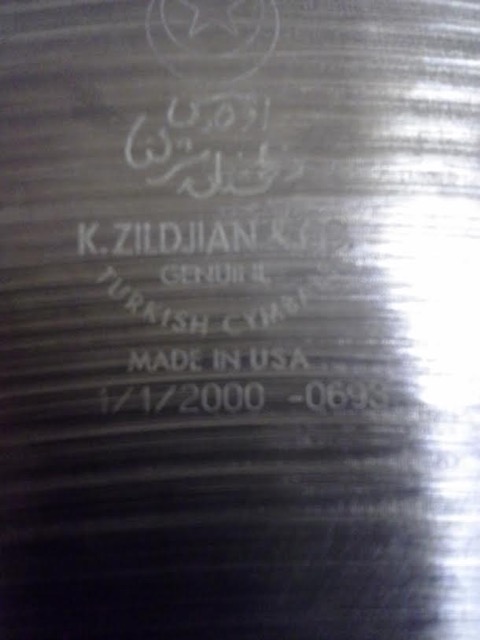
The first celebrates the new millennium. I don't know how many of these exist.

This work is licensed under a Creative Commons Attribution-ShareAlike 4.0 International License.